

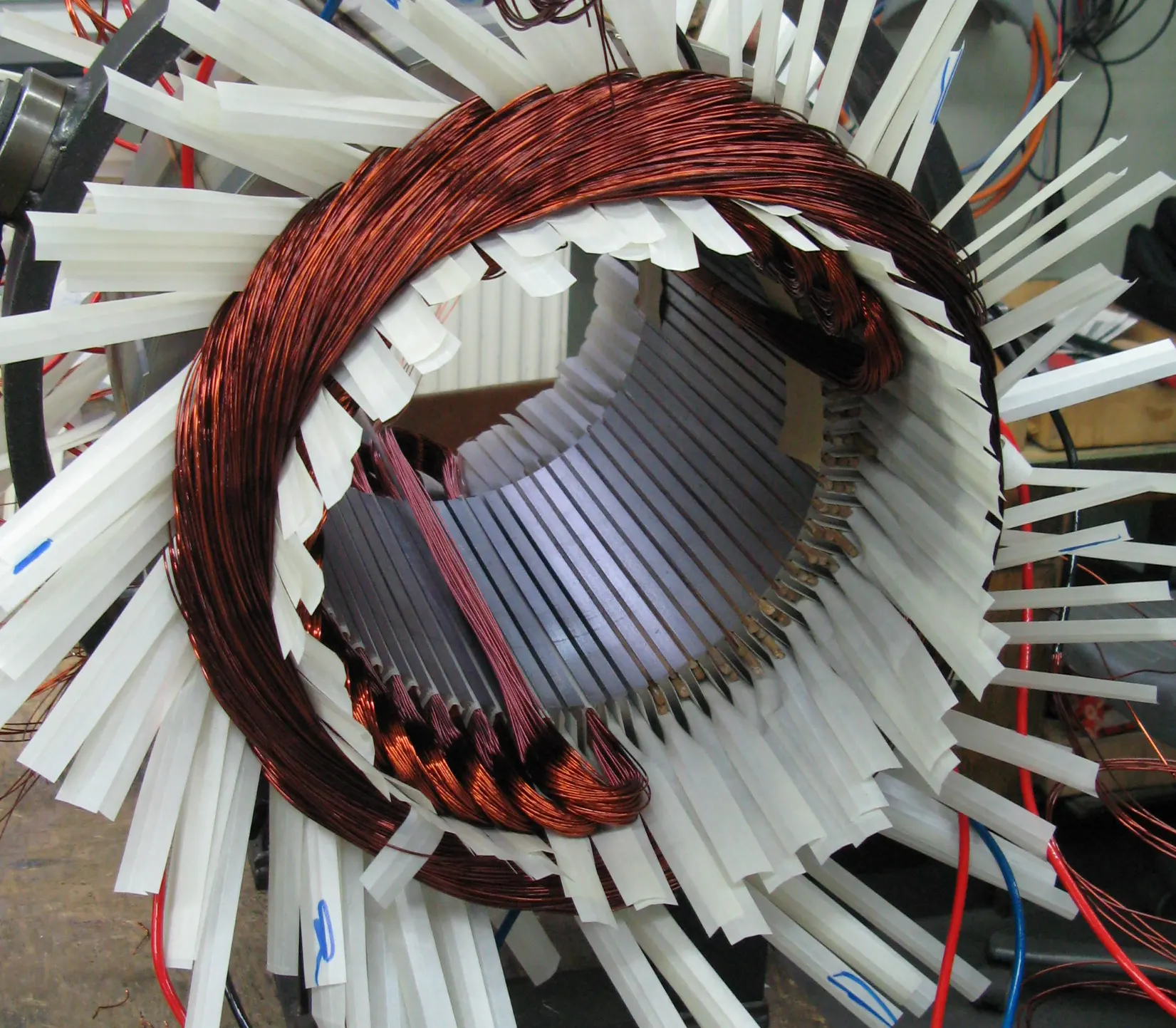
Designing an electric motor means fine-tuning countless factors to arrive at the best set-up for your application. Here, we look at how winding insulation directly impacts a motor’s performance, durability, and reliability. As the critical link between electrical safety and thermal stress, insulation is much more than just a “protective layer.”
A robust insulation system consists of several layers, each engineered to prevent different types of faults. The primary insulation forms the first barrier, right on the copper conductor, and prevents short circuits between turns within the same slot. The secondary insulation acts as a comprehensive protection system, adding an extra level of shielding for these wires from the electrical steel (slot walls). For multi-stranded windings, phase separators are added to keep winding strands and phases isolated from each other. Connection leads from the terminal box also require their own special insulation.
The Balancing Act: Copper vs. Insulation
A high slot fill factor is always the goal – the ratio of copper to insulation in each slot. More copper means less resistance and higher efficiency. But here’s the challenge: every extra micrometre of insulation material reduces the space available for more copper. Our job in design is to find exactly the right level of insulation: enough to guarantee safe operation and eliminate electrical breakdowns, but not so much that copper content – and therefore performance – drops too far.
Insulation details of a double-layer winding: slot-base insulation paper (slot box), slot wedges, and separator strips.
The Importance of Temperature Classes
A motor’s service life and performance are closely tied to its operating temperature. Motors fall into different temperature classes, each with a set maximum temperature. The allowable temp combines maximum ambient temperature at the installation site and any heat build-up from the motor’s own internal losses. Precise information about actual application conditions – even such details as local ambient temperatures – is essential. Defining the right temperature class also means selecting the insulation class, as specified in standard DIN EN 60085, which rates thermal performance. Insulation must be chosen to match its maximum permitted operating temperature for the intended class.
The Challenge of Inverter Operation: Protecting Against Partial Discharge
Many modern drives are operated using frequency converters. However, converter operation poses unique stresses such as high voltage rise rates. This can cause partial discharges – small electrical arcs that slowly degrade insulation over time on both a chemical and mechanical level. For motors running long-term with frequency converters, primary insulation must be designed specifically to withstand these voltage spikes and avoid eventual breakdown.
Insulation: The Key to Performance and Longevity
Quality winding insulation is one of the core aspects of our motor design philosophy. The careful balance between material thickness, thermal endurance and electrical capabilities is the secret behind durable, powerful motors that deliver high performance even when under extreme demands.